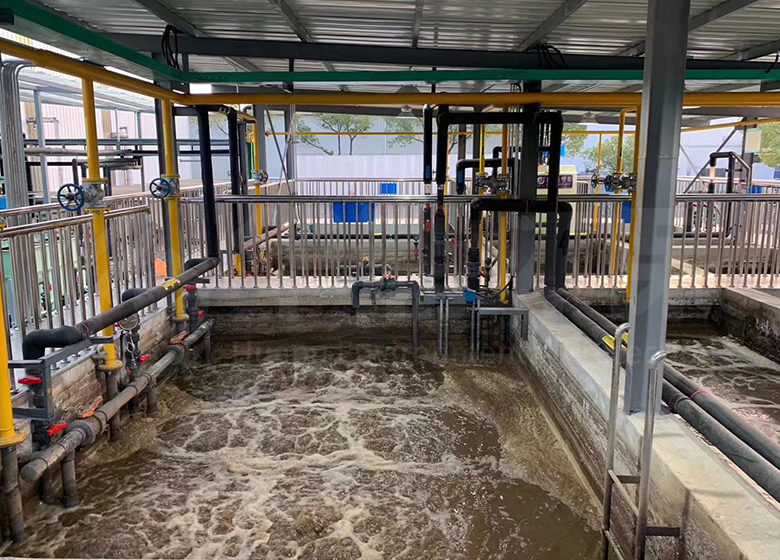
Parameter Description and Selection Points
The selection of filter types is determined based on the treatment objectives and water quality conditions: C tank (only removes organic matter), N tank (only removes ammonia nitrogen through nitrification), C/N tank (organic matter+partial nitrification), and DN tank (removes total nitrogen through denitrification). Large scale projects should adopt multi-level combination technology
The flow direction of the filter is selected as upward flow (mainstream, water flow from bottom to top, air-water in the same direction, which is conducive to the contact between pollutants and biofilm); Downward flow (reverse flow, water flows from top to bottom, water flows downwards, and air flows upwards, without the need for a secondary sedimentation tank); Composite flow (special requirements)
The design of water treatment capacity is determined based on the project scale. BAF has developed to a maximum scale of several hundred thousand tons/day and can be flexibly configured according to the processing capacity of a single tank. Multiple tanks can be connected in parallel or cascaded
The calculation of filter area A=Q/q (Q: design water volume m ³/h, q: hydraulic load m ³/(m ² · h)) requires calculation based on peak flow rate and reserved margin. The area of a single pool should not be too large (≤ 100m ²)
Calculation of filter material volume V=A × H × φ (A: filter area m ², H: packing layer height m, φ: packing coefficient 0.7-0.8), heavy filter material packing height 1.5-2m, light filter material 2.5-3.5m
The material of the pool structure is reinforced concrete (for large-scale projects, with good durability and the widest application); Carbon steel anti-corrosion (for small and medium-sized projects, with lower cost); Stainless steel (food grade or strongly corrosive working conditions). There are three types of pool shapes: circular, square, and rectangular (with an aspect ratio of 1.2-1.5)
Choose porous ceramic particles as the filter material (commonly preferred, with high strength, large specific surface area, and good chemical stability, the mainstream choice); Zeolite (with strong ammonia nitrogen adsorption capacity, suitable for high ammonia nitrogen wastewater); Volcanic rocks (high porosity, good biocompatibility); Activated carbon (deep treatment, large adsorption capacity); Lightweight polystyrene filter material (BIOSTYR process, density<water, suitable for special needs)
Filter material specification particle size: 2-5mm (commonly 3-5mm); Specific surface area: ≥ 1000m ²/m ³; Crushing rate: ≤ 5%; Bulk density: 0.75-0.95g/cm ³ (ceramic particles)
The material and thickness of the supporting layer are pebbles, with a thickness of 400-600mm, generally divided into 2-3 particle size gradations (from coarse to fine)
The water and air distribution system adopts arch shaped pipes for water and air distribution, filter plates (with filter heads arranged at the top of the filter tank), specialized air distribution devices, etc; The water distribution device is located in the bottom distribution chamber of the filter tank, and a filter plate is installed above the filter head; It should be ensured that the water and air distribution is uniform, anti clogging, and easy to maintain
The aeration system is selected based on the type of filter and load requirements. Common aeration devices include microporous aerators and single pore membrane air diffusers; Supporting fan: The required air volume for aerobic filters (C/N tank, N tank) is determined based on the air-water ratio and inlet flow rate; Supporting aeration pipeline system and valves
The backwash system adopts a three-stage backwash method of air washing, air water combined washing, and water washing: the air washing intensity is 10-15 L/(m ² · s), the water washing intensity is 10-15 L/(m ² · s), and the total backwash time is 5-10 minutes; Backwash cycle of 7-10 days (controlled according to head loss); Supporting backwash water pump, backwash fan, valve group and automatic control
If the reflux system adopts the DN filter+C/N filter denitrification process, the effluent from the C/N filter needs to be refluxed to the inlet of the DN filter, and the reflux ratio should be determined according to the denitrification requirements
The automation control system is fully controlled by PLC, and is equipped with online instruments such as level gauges, DO meters, pH meters, flow meters, turbidity meters, etc; It should have automatic control functions for the entire process of filtration and backwashing, and support local and remote monitoring. Key components such as PLC and pneumatic actuators should adopt internationally renowned brands
The BAF backwash wastewater from sludge treatment needs to be returned to the pre-treatment unit (regulating tank or primary sedimentation tank) for treatment; The remaining sludge production is relatively low and can be integrated into the factory's sludge treatment system for unified disposal
Installation method: Large scale projects adopt reinforced concrete pool type on-site pouring, and equipment is installed in place on site; Small and medium-sized projects can use integrated steel equipment or pry mounted integrated devices for on-site hoisting and positioning. Equipment foundation levelness error ≤ 2mm/m, accurate positioning of embedded parts ± 5mm
Winter operation measures: In cold regions, the pool body should be covered or built indoors, and the inlet pipeline should be insulated. If necessary, heating devices should be installed to prevent a decrease in biological activity
Following the standards T/CECS 265-2024 "Technical Code for Aerated Biological Filter Engineering", CJJ/T 152-2010 "Design Code for Aerated Biological Filter", CJ/T 47-2016 "Water Treatment Filter Bricks", GB 50014-2021 "Outdoor Drainage Design Standard", GB 18918-2002 "Pollutant Discharge Standard for Urban Sewage Treatment Plants"




 CN
CN



 National Service Hotline:400-611-6861