Product Introduction
The ion exchange resin hardness removal system uses sodium type cation exchange resin to replace scaling ions such as calcium (Ca ² ⁺) and magnesium (Mg ² ⁺) in water with sodium ions (Na ⁺), thereby achieving water quality softening. It is mainly used for boiler feedwater, industrial circulating water, and domestic water treatment.
When the raw water flows through the resin tank, Na ⁺ on the resin exchanges with Ca ² ⁺ and Mg ² ⁺ in the water, and Ca ² ⁺ and Mg ² ⁺ are adsorbed onto the resin. Na ⁺ enters the water, and the effluent is softened water.
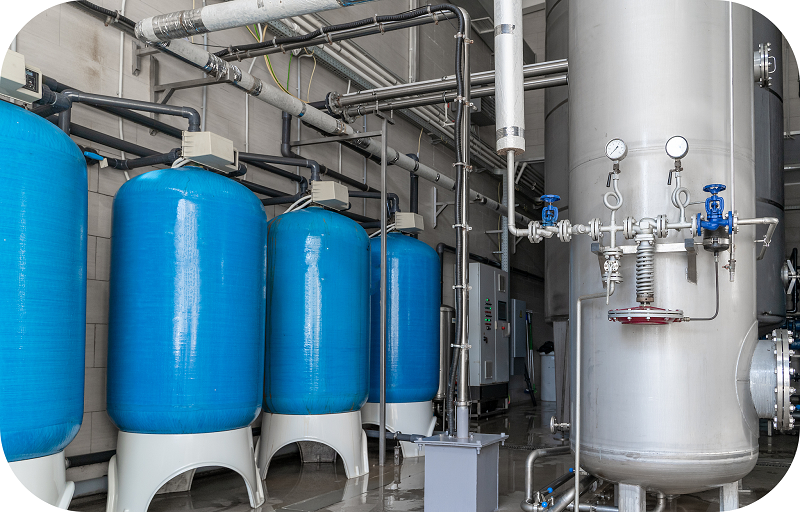
Equipment composition: resin tank (for storing resin)+salt tank (for storing recycled salt)+control valve (for automatically controlling the operation process)+pipeline valve.
Regeneration process: When the resin is saturated with adsorption, the system automatically flushes the resin layer with salt water, and Na ⁺ replaces Ca ² ⁺ and Mg ² ⁺ to be discharged, restoring the resin's softening ability. The ion exchange resin hardness removal system uses sodium type cation exchange resin to replace scaling ions such as calcium (Ca ² ⁺) and magnesium (Mg ² ⁺) in water with sodium ions (Na ⁺), thereby achieving water quality softening. It is mainly used for boiler feedwater, industrial circulating water, and domestic water treatment.
When the raw water flows through the resin tank, Na ⁺ on the resin exchanges with Ca ² ⁺ and Mg ² ⁺ in the water, and Ca ² ⁺ and Mg ² ⁺ are adsorbed onto the resin. Na ⁺ enters the water, and the effluent is softened water.
Equipment composition: resin tank (for storing resin)+salt tank (for storing recycled salt)+control valve (for automatically controlling the operation process)+pipeline valve.
Regeneration process: When the resin is saturated with adsorption, the system automatically flushes the resin layer with salt water, and Na ⁺ replaces Ca ² ⁺ and Mg ² ⁺ to be discharged, restoring the resin's softening ability.
Equipment Selection
1. Determine the operating mode
The selection of equipment operation mode is mainly based on whether interruption of water usage is allowed:
Intermittent water supply: It is recommended to use a single valve and single tank configuration. In this mode, the device will stop producing water during regeneration, which is suitable for intermittent water use scenarios that can accept short-term water maintenance.
Continuous water supply required: It is recommended to use a one in use and one backup or dual tank configuration. When one set of tanks is regenerated, another set of tanks can continue to operate, achieving 24-hour uninterrupted water supply.
2. Core parameter calculation
The three core parameters and their acquisition methods for equipment selection are as follows:
Hourly processing capacity: The unit is tons per hour (t/h), which is usually provided directly by the user and serves as the basis for determining equipment specifications.
Raw water hardness: The unit is milligrams per liter (mg/L), which needs to be obtained through water quality testing. The higher the hardness of the raw water, the greater the amount of resin required to remove these ions.
Periodic water production: The unit is cubic meters (m ³), which determines the regeneration frequency of the equipment. The calculation formula is: the total amount of resin multiplied by the resin working exchange capacity, and then divided by the hardness of the raw water.




 CN
CN

 National Service Hotline:400-611-6861