CN

Product Center

Green Innovation · Scientific and Technological Development · Industrial Responsibility · Joint Construction of Civilized Ecology

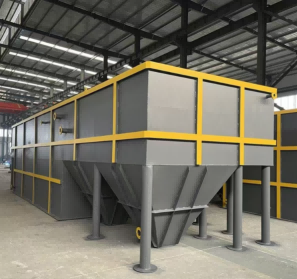
inclined tube settling tank

The inclined tube sedimentation tank is widely used in water treatment plants for raw water purification, advanced treatment of urban sewage and sludge concentration, industrial wastewater treatment (electroplating, printing and dyeing, chemical industry, coal mining, leather making, food, etc.), reclaimed water reuse, and dust removal wastewater treatment in power plants. It can be used for new construction projects and is also suitable for retrofitting existing horizontal and vertical sedimentation tanks to improve treatment capacity, especially for removing SS and some COD in high turbidity, high algae raw water and sewage deep treatment.

National Service Hotline:400-611-6861
Product Introduction

The inclined tube sedimentation tank is an efficient sludge water separation device based on the "shallow tank theory". It consists of an inlet water distribution area, an inclined tube sedimentation area, a clean water collection area, and a sludge collection area. The sedimentation area is increased and the sedimentation distance is shortened through dense honeycomb shaped inclined tubes. The common type is opposite flow (upward flow), and the inclined pipe material is commonly PP, PVC, fiberglass or stainless steel. The inner diameter of the tangential circle is 25-80mm, the inclination angle is 60 °, and the length of a single pipe is 800-1200mm. The raw water passes through the inclined pipe from bottom to top, and the floc settles and slides down, while the clear water rises and flows out.

Technical Advantage
High sedimentation efficiency
Based on the shallow pool theory, the sedimentation efficiency can be increased by 50% to 60% compared to a horizontal sedimentation tank, with a flow rate of up to 36m ³/(m ² · h) and a processing capacity 710 times higher than that of a conventional sedimentation tank. The Reynolds number of the water flow in the inclined tube is low (about 200), the Froude number is stable (10 ⁻³ 10 ⁻⁴), and the water flow is laminar, which is conducive to particle settling.
compact footprint
The water production per unit area is 2-4 times that of a horizontal sedimentation tank, which can save more than 40% of the occupied area, and the construction period is only 1/5 of that of a horizontal sedimentation tank.
good effluent quality
Combined with flocculation technology, the effluent turbidity can reach below 3NTU, and with subsequent filtration, it can reach within 1NTU, meeting the water quality requirements for domestic drinking water and recycled water.
Low operating energy consumption
Adopting the principle of gravity precipitation, no external power is required, and the operating cost is low. Due to its high precipitation efficiency, it can save about 5% to 10% of coagulant dosage.
Process Selection

Municipal Water Supply: Complying with ≤6 m³/m²·h

Inclined Tube Specifications

Material: PP / PVC / Stainless steel

Shape: Regular hexagonal honeycomb

Inscribed circle diameter: 25–35 mm (commonly 30 mm)

Tube length: 1.0–1.2 m

Installation inclination angle: 60°

Tank Layer Heights

Clear water zone: 0.8–1.2 m

Buffer/distribution zone: ≥1.0 m

Sludge discharge: Gravity sludge discharge, 1–2 times per day

Applicable Standards

GB50013-2018 – Standard for Design of Outdoor Water Supply

GB50335-2016 – Code for Design of Municipal Wastewater Reclamation and Reuse

GB50014-2021 – Standard for Design of Outdoor Wastewater Engineering